
Project Overview
Our Purpose Behind the Project
People with hearing loss face considerable challenges. They experience and navigate the world much differently than those with complete hearing.
We got to know how their hearing loss causes them to be dependent on others for even a basic task. People with hearing loss have social withdrawal due to reduced access to services and difficulties communicating with others.
Emotional problems caused by a drop in self-esteem and confidence, this is when we thought to come up with an idea to at least solve the problem of communication where they can be independent and get more social.
About the Project
We decided to create an inclusive communication solution that facilitates seamless interaction for individuals with hearing loss and enables them to effectively communicate with others in their surroundings.

My Role & Responsibilities
-
Secondary research
-
Competitive analysis
-
Framing interview questions
-
Helped team with conducting surveys
-
Helped team with survey analysis
-
Story board
-
Journey mapping
-
Information architecture
-
Helped team with low & high fidelity wireframes

Problem Statement
Problem Description
Technological interventions have already come a long way in helping people who lack their complete ability to hear. But still they're not perfect.
Currently, there is no tool or way for the people with hearing loss to communicate easily, hearing aids are not completely effective for those with no hearing and some users find them uncomfortable or ideologically opposed to them.
Sign languages are preferred because people who are born with hearing loss are uninformed about the languages spoken by others, and hand gestures are an easy way to convey messages.
Hence, we need to come up with a solution that can make it easier for the people with hearing loss to communicate in sign language and for others to be able to understand it and making everyone aware of the sign language.
Why this Happens
-
Lack of awareness
-
Less education opportunities
-
Fewer platforms to communicate
Possible Approach
-
Build an easy communication platform
-
Create awareness about this issue
-
Create a Bluetooth device with motion sensors or camera to detect sign languages
-
Make people understand about the people with hearing loss
-
Create an user-friendly UI
Defining Objectives
-
To design a minimal & user friendly system which helps community of people with hearing loss.
-
To bridge the communication gap between people with hearing loss and people with complete hearing ability.

Methodology


EMPATHIZE
Design Strategy

Goal
The intent is to provide a seamless and user-friendly platform for people with hearing loss to communicate with ease and gain a sense of independence, also creating different job and educational opportunities.
Competitors
The existing apps focus on teaching sign languages that might not interest the all the users. The UI of the app that have feature of translating the text to sign language lacks to meet the user’s needs.
Target Audience
Primary : Above 10 Yrs
People with hearing loss
Secondary: Those who comes in contact with people having hearing loss. Colleagues, teachers, friends, relatives, etc.

Tasks to be Performed
-
Scan the QR code to start communicating
-
Scan the sign language interpreted by the person with hearing loss using the camera to get the text translation.
-
Type/speak in the microphone for sign language translation
Success Factors
-
Sign Language to text translation
-
Text to sign language translation
-
Voice to sign language translation
-
Chat feature to give some more independence socially.
-
Avoiding any misinterpretation of sign language and making the conversation easy and quick
Competitive Analysis
The purpose of a competitive analysis is to understand competitors' strengths and weaknesses in comparison to our own product and to find a gap in the market. A competitor analysis is important because: It will help to understand how to enhance our own product.
-
We took a list of competitors and studied their profile
-
We analyzed their functionalities i.e., Feature Analysis and the constraints used to keep the user hooked to the app to understand What worked? & Why it worked?.
-
We used their product personally & referred play store/ app store reviews on the product.
-
At last we conducted SWOT Analysis of competitors. The key metrices of SWOT analysis are Strength, Weakness, Opportunities & Threats.


User Research
Secondary Research
We’ve gone through information about the people with hearing loss. We could gather information about the situation worldwide and tried to analyze based on the same. Also got information about sign language and it’s usage that helped us to get insights on understanding the user behavior, motivations and needs.
About People with Hearing Loss
-
We found that profound hearing loss, which implies very little or no hearing. They often use sign language for communication.
-
There are only about 250 certified sign language interpreters in India, translating for a population of profound hearing loss between 1.8 million and 7 million.
Challenges faced by people with hearing loss
-
Communication barriers: Person with hearing loss may struggle with communicating with people who don't understand sign language or have limited knowledge of it.
-
Access to information: Lack of access to audio information such as in public announcements, television or live events.
-
Employment discrimination: Individuals with profound hearing loss may face challenges finding employment due to communication barriers and lack of accommodations in the workplace.
-
Social isolation: Individuals with hearing loss may face challenges building relationships and participating in social activities due to communication barriers.
-
Limited access to healthcare: Individuals with hearing loss may struggle to access quality healthcare services due to communication barriers and lack of sign language interpreters.
-
Educational challenges: Students with hearing loss may face barriers to receiving a quality education due to lack of access to appropriate resources and accommodations.
-
Technological challenges: Individuals with hearing loss may struggle to access information and communication technologies that rely on audio.


Primary Research
We visited Adhaar muk-badhir Vidyalay and Swarnaad Institution to conduct the User Interview and get a detailed insight of the situation. We interacted with the teachers, principle and parents of the children studying at the institutes. The interview help us understand the problems faced by the children and people around them and empathize to the situation.


Interview Questions
-
How many people with hearing loss prefers sign language?
-
Which sign language do they prefer?
-
Do you think having hearing loss creates limitations on lifestyle?
-
Is there any device/solution they use for this?
-
Can a person with hearing loss read normal language?
-
Are they comfortable with any other person with complete hearing ability?
-
What will be better for them to understand the concept? Sign language, Visual representations or both?
-
Does Indian sign language differs state to state?
-
Which form of employment does person with hearing loss prefer for him/her?


Affinity Mapping

DEFINE
User Persona


Empathy Mapping


Story board of person with complete hearing ability communicating through scanner

User Journey Mapping
A journey mapping of how a person with hearing loss feels while socializing with people before using ‘Hear it’ app and then how it improves their perception towards society.

IDEATE
How Might We?
HMW questions that could be used to design solutions for population of people with hearing loss:
-
HMW improve communication access for individuals having hearing loss in daily life?
-
HMW provide equal educational opportunities for children and students having hearing loss?
-
HMW increase the accessibility of public spaces and events for individuals with hearing loss?
-
HMW improve the availability of healthcare services for people with hearing loss?
-
HMW increase the visibility and recognition of people having hearing loss culture and sign languages?
-
HMW enhance the employment opportunities and career advancement for individuals having hearing loss?
-
HMW improve the accessibility of technology and information for individuals having hearing loss?
-
HMW increase the awareness and understanding of the challenges faced by people having hearing loss?
Information Architecture
We created Information architecture flowchart which focuses on organizing, structuring, and labelling content. Here we got an idea of how to arrange information in the app we are planning to design
%202.png)
User Flow
As our app have primary and secondary users, we planned to create different flow charts for different users
Primary users: People with hearing loss
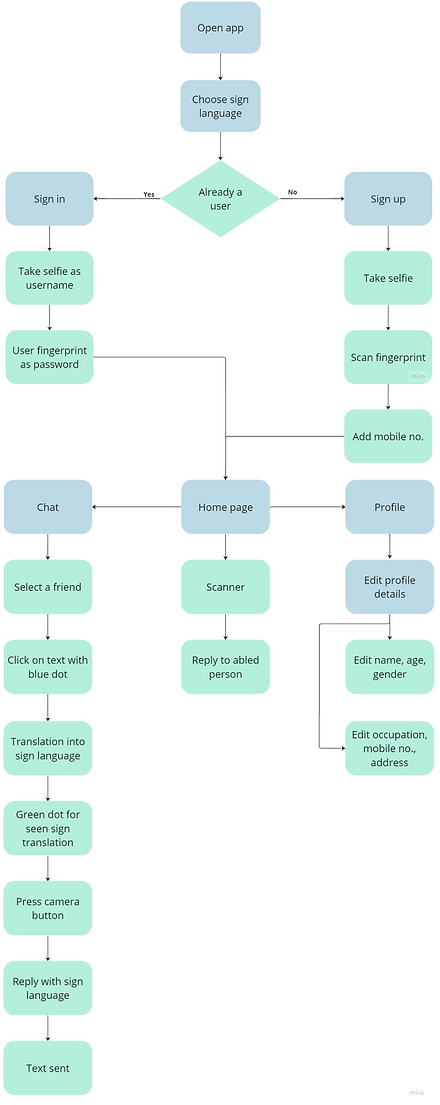
Secondary users: people with complete hearing ability
Connects through scanner
%201.png)
Uses app

DESIGN
Low fidelity wireframes
Based on the Information Architecture and user flows we created low fidelity wireframes for screens.


High Fidelity Wireframes
Sign up/ Sign in screens


Home screen, chats & profile


Person with complete hearing ability connecting temporarily


Person with complete hearing ability who uses app


Project Summary
During the project, we managed to study the situation in detail and empathize with users. We conducted surveys and learned the appropriate and correct methods to do so giving us a deeper understanding of how people think and behave and connecting us to the the users and their problems.
This project was demanding and time consuming which challenged us in various ways and led us to explore newer and easier ways to form a solution.
My learnings
-
Designing for people with hearing loss needs a deep understanding of their unique needs, challenges, and preferences.
-
I learnt to cultivate empathy and prioritize user-centered design, ensuring the app meets the specific requirements and goals of target users.
-
Creating such an app highlighted the importance of accessibility and inclusive design.
-
Strong understanding of how collaboration with experts in audiology, accessibility, and different domains works.
-
I learnt the value of interdisciplinary collaboration and the benefits of involving domain experts throughout the design process.
-
I gained insights into different perspectives, this expanded my knowledge base, and developed collaborative skills to create more impactful solutions.

Person with hearing loss who uses app

Person with complete hearing ability who joins through scanner

Person who can hear completely and uses app